
How do insurers suddenly 'know' my health risk from a 30-second video?
An insurance-technology analysis of how an insurer health risk 30 second video workflow can infer limited risk signals from camera-based vitals, identity checks, and underwriting models.
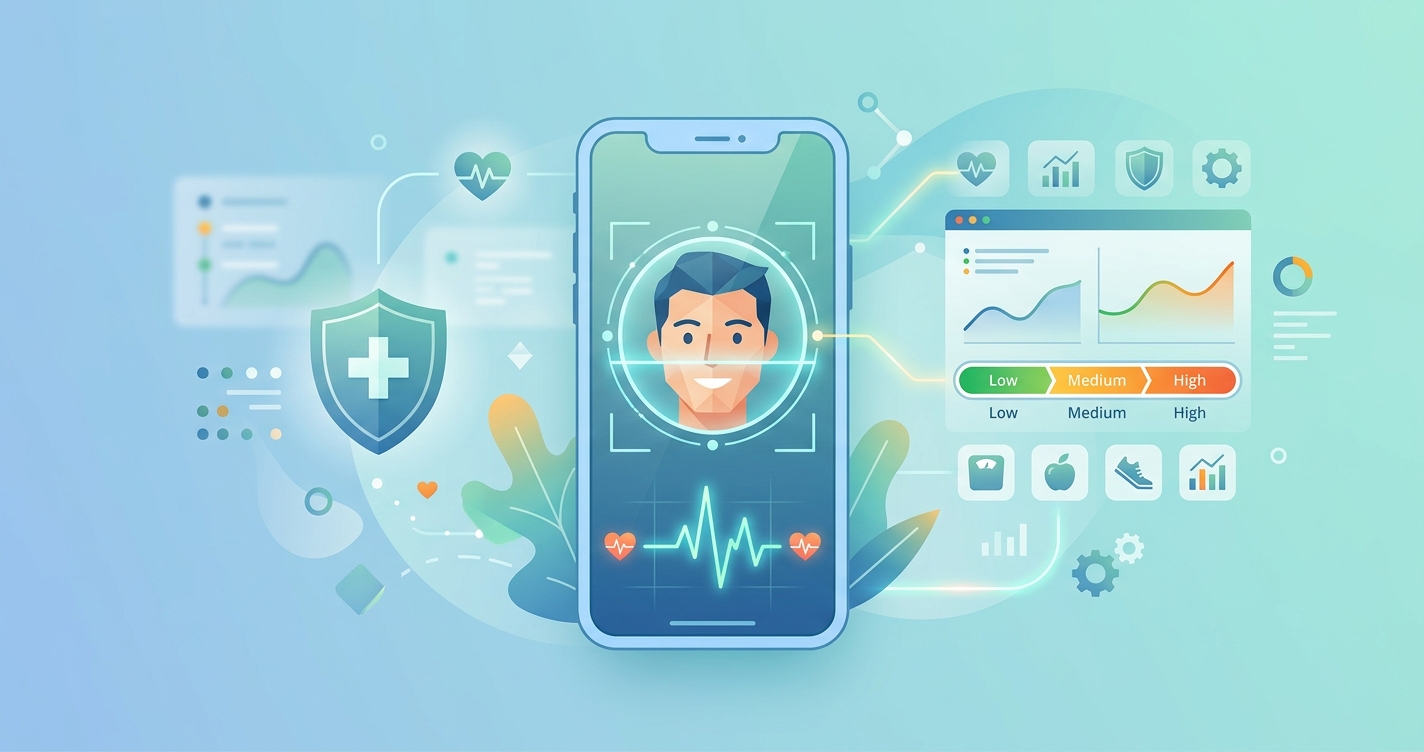
If an insurer seems to learn a lot from a 30-second selfie video, the short answer is that the video itself usually is not doing all the work. In most modern underwriting flows, that half-minute clip is one input in a larger decision stack: identity checks, liveness detection, historical application data, third-party records, and camera-based vital-sign estimation all get combined into a narrower question insurers actually care about, which is whether the applicant fits a risk band quickly enough to keep the digital journey moving.
"Insurers should establish and maintain a written program for responsible use of AI systems across the insurance life cycle, including underwriting." — National Association of Insurance Commissioners, Model Bulletin on the Use of Artificial Intelligence Systems by Insurers, December 2023
Insurer health risk 30 second video analysis
The phrase sounds more dramatic than the underlying mechanics. A 30-second video does not let an insurer read your entire medical history. What it can do is help a digital underwriting platform capture a few high-value signals without sending the applicant to a lab or paramedical exam.
Most of those workflows rely on remote photoplethysmography, or rPPG. The method estimates pulse-related changes from subtle color variation in the face. RGA described photoplethysmography as an electro-optic technique that detects minute shifts in blood vessels under the skin and can be used to derive measures such as heart rate, respiratory function, oxygen saturation, heart rate variability, and stress-related indicators. That is why the insurance industry keeps paying attention to camera-based capture: it turns an ordinary smartphone session into a potential health-data collection point.
That still does not mean the insurer has a magic health oracle. What the system usually gets is a compact bundle of signals:
- identity and liveness confirmation from the video session
- pulse-derived vital-sign estimates or session-quality metrics
- timestamp, device, and geolocation-adjacent metadata depending on consent and workflow design
- application answers already provided by the customer
- external underwriting data, such as prescription or claims-related records where permitted
- rule-engine outputs that place the applicant into pass, review, or refer buckets
That last point matters most. Underwriting systems do not need perfect certainty from the video. They need enough evidence to route the case.
| What the 30-second video can contribute | What it usually cannot do alone | Why insurers care | |---|---|---| | Liveness and session integrity checks | Replace a full medical record | Helps reduce fraud and identity mismatch | | Pulse-related signal capture from facial video | Deliver a complete diagnosis | Supports faster triage in digital flows | | Session-quality and confidence data | Guarantee every applicant fits one model | Lets rules engines decide when to accept or review | | A smoother customer experience than an exam | Remove governance, bias, or compliance obligations | Keeps abandonment risk lower in quote journeys | | Structured data for APIs and decision engines | Explain a final decision without the rest of the stack | Fits straight-through underwriting workflows |
A better way to think about it is this: insurers are not suddenly "knowing" everything. They are shrinking the number of unknowns early in the application.
Why insurers are trying to compress health screening into a short session
Speed has become a distribution issue, not just an operations issue. McKinsey's work on digital and AI-powered life-insurance underwriting argues that carriers can cut cycle times by 50% to 70% and reduce administrative expense by 20% to 30% when underwriting is redesigned around digital data capture and automation. That does not guarantee a better underwriting model by itself, but it explains why insurers want a thirty-second interaction instead of a week of follow-up.
There is also a conversion problem. The longer an applicant waits, the more likely the process spills into abandonment, channel switching, or manual review. Jeffrey Dean and Luiz André Barroso made the broader systems point back in 2013 in The Tail at Scale: once a user request depends on many services, small outliers start affecting a large share of real sessions. Digital underwriting platforms live that problem every day. If identity, enrichment, risk scoring, and policy-admin writes all sit in the same path, even a good model can feel slow.
So the 30-second video is partly about health data and partly about keeping the synchronous path short enough to preserve conversion.
Industry applications
Consumer life and health application flows
In direct-to-consumer channels, the video session often replaces some of the friction that used to come from scheduling exams, answering repeated health questions, or waiting for follow-up. The commercial goal is simple: collect enough structured evidence for an instant or near-instant underwriting outcome.
Insurtech underwriting platforms
For platform vendors, the video is useful because it produces API-ready data. The session can be normalized, scored, and passed into orchestration layers that already handle identity, fraud, eligibility, and pricing. That is the same architecture logic behind posts like Underwriting Platform Latency: How to Keep Risk Scoring Under 500ms, where the real challenge is not one model but the full request path.
BPO and operations teams
Business-process outsourcing teams care about a different metric: file cost. If a short video helps separate clean files from cases that need a human underwriter, the economics can change quickly. Fewer outbound calls, fewer exam scheduling loops, and fewer incomplete files can matter as much as the scoring itself.
- Fast-pass cases can move through straight-through rules.
- Borderline cases can be routed to manual review with better context.
- Poor-quality sessions can be retried immediately instead of failing days later.
- Audit logs become easier to store when the session is already structured for an underwriting API.
Current research and evidence
The evidence is promising, but it is more nuanced than the marketing shorthand suggests. In a 2024 Journal of Clinical Monitoring and Computing paper, Chi Pham and colleagues evaluated video plethysmography in 216 surgical patients. They reported 99% success in capturing both blood pressure and heart rate, and the method showed a strong correlation of 0.85 for heart rate against standard devices. Blood-pressure performance was much weaker: correlation was 0.48 for systolic blood pressure and 0.29 for diastolic pressure. That is a useful reminder that camera-based measurement may be solid for some signals and less mature for others.
RGA has been unusually direct about the insurance implication. Its review of photoplethysmography for insurance said smartphone-based capture could augment underwriting and potentially reduce the need for some physical exams, but also stressed that large-scale clinical studies are still needed. That is about the right level of confidence for this market right now.
The fairness question is just as important. A narrative review of 32 rPPG datasets found that many datasets underrepresent age, sex, ethnicity, and patient populations. The authors warned that models trained on those datasets may not generalize cleanly in real-world use. For underwriting teams, that is not an academic side note. It is a governance issue, because underwriting systems touch regulated decisions.
That concern lines up with the NAIC's December 2023 AI model bulletin. The bulletin does not ban AI in underwriting. It does insist that insurers maintain written governance programs, test for adverse consumer outcomes, and oversee third-party systems used in regulated insurance functions. In plain English: a fast video workflow may be attractive, but the compliance burden does not disappear just because the capture happens on a phone.
The future of video-based risk scoring in insurance
I think the most likely outcome is not that thirty-second video replaces underwriting. It becomes one reliable layer inside underwriting.
The strongest platforms will probably treat video capture as a session-based evidence source that works best when paired with:
- explicit consent and clear disclosures
- liveness and fraud controls
- confidence thresholds for signal quality
- fallbacks to manual review or alternative evidence
- audit trails that explain which inputs affected the routing decision
That architecture is much more believable than the sci-fi version where a camera alone decides everything. It also matches where the technology seems to be heading. ClinicalTrials.gov now lists community validation work comparing rPPG-derived cardiovascular parameters against standard measurements and risk scores, which suggests the field is still in the "measure, compare, and narrow the gap" stage rather than the "settled commodity" stage.
For insurers, that is enough to justify experimentation. For applicants, it explains why the process can feel startlingly fast without being mystical. The platform is not reading your future from your face. It is collecting a narrow set of machine-readable signals and using them to reduce underwriting uncertainty earlier than older workflows could.
Frequently Asked Questions
Can a 30-second video tell an insurer everything about my health?
No. A short video can contribute limited signals such as liveness, session quality, and some pulse-derived measurements, but underwriting decisions usually also depend on application data, external records, and business rules.
Is camera-based underwriting mostly about fraud checks or health metrics?
Usually both. Many platforms use the same session to verify the applicant is real, confirm the capture quality, and collect structured physiological signals that can support faster routing.
Are camera-based vital signs already perfect enough for all underwriting uses?
No. Research looks stronger for some measures, such as heart-rate capture, than for others such as blood-pressure estimation. That is one reason governance thresholds and fallback paths still matter.
Why would an insurer prefer a short video to a traditional exam?
Because it can reduce friction, shorten cycle times, and help separate straightforward files from cases that need more review. For digital channels, that speed can have real commercial value.
For underwriting teams building these workflows into production systems, Circadify's custom underwriting environments are built around API delivery, risk scoring, and digital-review operations rather than one-off demos. Related reading: Predictive Underwriting with Vitals: How to Validate Model Drift and 5 Integration Patterns for Adding Vitals Data to Policy Admin Systems.